I asked AI to tell me about the pyramids of Giza and their geometric marvel. Here's what it wrote.
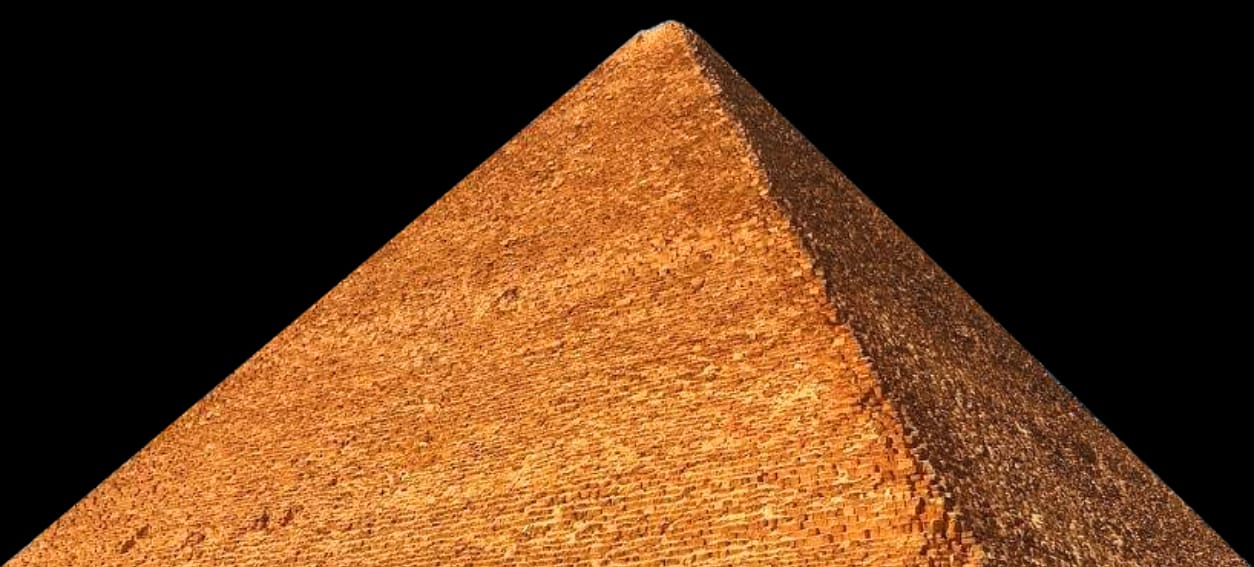
The Great Pyramid Is Not Impossible. It Is Something More Interesting.
The Great Pyramid of Giza has suffered from a strange kind of compliment. Because it is so large, so old, and in places so astonishingly precise, people often treat it as though ordinary human engineering could not possibly explain it. That instinct is understandable. It is also probably wrong.
The more interesting conclusion is that the pyramid was built by humans using technologies we broadly understand—stone and copper tools, ropes, sledges, boats, ramps, levers, surveying instruments, and an enormous administrative machine—yet the exact choreography of those technologies is still unresolved.
We do not have a missing civilization problem. We have a missing construction manual.
The precision is real, but it is not uniform
Khufu’s pyramid originally stood about 146.6 meters high on a base roughly 230 meters square. Estimates commonly place its stone count around 2.3 million blocks, although that number is approximate. Most are limestone; some granite elements weigh tens of tons. Nature
Its orientation deserves the reputation. Surveys show the Great Pyramid aligned to the cardinal directions to within roughly four arc-minutes—about one-fifteenth of a degree. Engineer Glen Dash has experimentally shown that a simple solar-shadow method around the equinox can produce accuracy in the required neighborhood. Stellar methods remain plausible as well. True-north precision does not require a lost instrument. It requires patient observation, repeatable procedure, and excellent quality control. Dash Foundation
The geometry is similarly impressive but easy to mythologize. A commonly reconstructed design of 440 royal cubits per side and 280 cubits high yields the familiar 14:11 rise-to-half-base relationship. That creates numerical relationships resembling π closely enough to inspire generations of theories. But a relationship appearing in the dimensions is not evidence that π, the golden ratio, Earth’s circumference, or some encoded global constant was the architect’s intention. Egyptian builders had a practical slope system, the seked, capable of explaining the form without smuggling modern mathematics backward in time. Giza Media
And the entire pyramid is not machined to jewelry tolerances. Some casing joints and selected interior work are extraordinarily fine, while much of the core masonry is irregular. That pattern looks like intelligent allocation of labor: precision where geometry, finish, load, or symbolism demanded it; speed where it did not. Nature
What was it actually for?
The strongest archaeological answer remains the least exotic: the Great Pyramid was the central monument in Khufu’s royal funerary complex.
That conclusion does not depend on finding a mummy inside. It comes from context. Royal pyramid complexes included mortuary temples, valley temples, causeways, priestly cult activity, subsidiary pyramids, cemeteries, and—in Khufu’s case—boat pits. The landscape belongs to the Egyptian machinery of kingship, death, rebirth, and continuing cult. Digital Giza
My confidence ratings are:
| Hypothesis | Confidence |
|---|---|
| Primarily a royal funerary monument/tomb for Khufu | 95/100 |
| Also a statement of divine kingship and state power | 93/100 |
| Significant solar/cosmic symbolism shaped parts of its design | 80/100 |
| Primarily an observatory, energy device, archive, or non-funerary machine | <5/100 |
These are analytical confidence scores, not archaeological measurements, and multiple purposes can coexist. A monument can be a tomb, religious apparatus, political statement, and demonstration of state capacity without being secretly something else.
The construction problem is mostly a logistics problem
The Diary of Merer may be the best reality check in the debate. The Wadi al-Jarf papyri describe Merer and his crew transporting fine Tura limestone by boat to Akhet-Khufu—“Horizon of Khufu”—late in Khufu’s reign. Archaeology at Giza has also uncovered a large settlement with bakeries, workshops, administrative buildings, livestock facilities, storage, and evidence for an institutionally provisioned workforce. AERA
That changes the mental picture. The pyramid was not thousands of anonymous men dragging random stones uphill. It was a national supply chain.
Local limestone could be quarried close to the plateau. Fine casing stone arrived by water. Granite came from farther south. Food, tools, rope, timber, copper, skilled masons, surveyors, haulers, boat crews, administrators, and rotating labor forces all had to arrive at the right time. The monument is as much evidence of scheduling and throughput as stonecutting. Nature
That leads to the construction hypothesis I find most convincing: there probably was no single “pyramid-building method.”
The lower courses favor broad, high-throughput hauling. As the structure rises, long straight ramps become increasingly expensive in material and space. The rational response is to change the transport topology with height—shorter ramps, edge ramps, switchbacks, levering, temporary platforms, and possibly internal or counterweight-assisted systems in selected zones.
Modern imaging also reminds us how incomplete the blueprint remains. Muon radiography revealed a void at least 30 meters long above the Grand Gallery in 2017; later work characterized a roughly nine-meter North Face Corridor. Their functions remain unresolved. Nature
Recent engineering models strengthen the case for changing methods with height. A 2026 computational study found that an edge-integrated multi-ramp system can produce schedules around 20–27 years when quarrying, transport, and seasonal interruptions are included. A 2025 paper proposes that internal passages such as the Grand Gallery may have participated in counterweight lifting. Intriguing, yes. Solved, no. Nature
My probability-weighted construction read:
- 65% — evolving hybrid of sledges, lubricated haulways, external/edge ramps, levers, and temporary staging.
- 25% — the same system with meaningful counterweight or internal-ramp assistance.
- 9% — a different combination of known Old Kingdom simple machines and hauling techniques.
- 1% — technology fundamentally outside the archaeological record.
A possibility hiding in plain sight: the pyramid as a production system
The underappreciated technology may have been organizational.
Imagine the project not as a building site, but as a distributed factory whose final assembly line happened to be 146 meters tall. Quarry crews produced standardized-enough stone. Transport crews maintained flow. Survey teams preserved reference lines. Masons corrected local fit. Ramp crews altered infrastructure as geometry changed. Administrators provisioned the workforce. Separate teams could work simultaneously on quarrying, hauling, dressing, setting, and finishing.
This also offers a mundane explanation for extraordinary accuracy: precision was probably layered into the process rather than rediscovered for every block. Establish a high-quality survey network, preserve datums, repeatedly check corners and slope, and errors remain bounded. Modern engineering works the same way. The secret is rarely one genius measurement; it is a system that prevents small mistakes from becoming large ones.
How long did it take?
Khufu’s reign provides an obvious constraint, and Merer’s records show major material movement occurring late in it. Combining that historical frame with modern logistics modeling, I would place the probabilities roughly here: AERA
- 20–27 years: 65%
- 15–20 years: 20%
- 27–35 years: 10%
- under 15 or over 35 years: 5%
A twenty-year schedule sounds impossible only if every block is imagined as one serial task. Thousands of operations could occur in parallel.
Could we build it today?
Absolutely. The mystery is not whether modern civilization possesses the engineering capability.
With laser surveying, diamond wire saws, crawler cranes, heavy-haul vehicles, GPS, CAD, hydraulic jacks, and modern project management, the geometry would be straightforward. The difficult part would be quarry volume, transportation, site logistics, labor, cost, environmental approval, and the wonderfully absurd question of who would finance a roughly six-million-ton stone monument. Nature
My rating: 6/10 engineering difficulty, 9/10 megaproject difficulty.
Rebuild it using only plausible Fourth Dynasty tools and materials, however, and the rating becomes 10/10—not because it violates physics, but because almost no modern organization has practiced that entire technological ecosystem at full scale.
That is what makes the Great Pyramid extraordinary. Its builders did not need aliens, vanished super-machines, or impossible mathematics. They needed something arguably more impressive: accumulated craft knowledge, disciplined measurement, a state capable of moving people and material at enormous scale, and a construction process sophisticated enough that 4,500 years later we can see the result while still arguing about the workflow.
The pyramid is not evidence that ancient Egyptians could do the impossible.
It is evidence that our intuition about what organized humans can accomplish is often much too small.